
Money Affirmations That Actually Rewire Your Subconscious
(Science-Backed)

If you’re repeating money affirmations like “I am rich” or “Money flows to me effortlessly,” yet see no change in your finances, you’re not alone. These affirmations often fail not because the concept is flawed, but because most people are taught to use them ineffectively. The real issue lies in the way affirmations are practiced, not in affirmations themselves.
Traditional money affirmations often fail because they directly conflict with your current reality. If your bank balance is $200 and you tell yourself, “I am wealthy,” your subconscious mind rejects it as false. Instead of creating abundance, these affirmations reinforce the divide between your reality and your goal, leading to more scarcity-minded thinking.
Fortunately, there is a method, supported by behavioral science, for making money affirmations work. By understanding how the subconscious processes information and using specific, action-based language, you can bypass resistance. This approach is the key difference between affirmations that create change and those that only provide momentary comfort.
Why Your Brain Rejects Traditional Money Affirmations
Your subconscious mind runs about 95% of your life on autopilot. It’s responsible for your automatic thoughts, emotional reactions, and habitual money behaviors. The challenge is that this part of your brain was programmed early in life, often before you were seven years old, when your mind was in a highly suggestible state similar to hypnosis.
During those formative years, you absorbed messages about money from your parents, your environment, and your experiences. If you grew up hearing “we can’t afford that” or “money doesn’t grow on trees,” those statements became part of your subconscious programming. Decades later, even though your adult self wants financial abundance, your subconscious is still running the old scarcity script.
When you try to use affirmations like “I am a millionaire” while your subconscious holds a deep belief that people like you don’t become millionaires, you create cognitive dissonance. Your conscious mind is saying one thing, but your subconscious knows it’s not true based on current evidence. The result? The affirmation gets rejected, and you might actually feel worse because you’re now aware of the gap between your affirmation and your reality.
Research on scarcity mindsets shows that when people feel financially stressed, it actually reduces their cognitive capacity and impairs decision-making. Studies have found that financial stress can effectively reduce IQ by about 13 points because so much mental bandwidth is consumed by worry. This means that simply repeating positive statements isn’t enough when your brain is locked in scarcity mode and literally working against you.
The Childhood Programming That Controls Your Money Story
Most of our deeply held beliefs about money were formed before we could even question them. Between birth and around age seven, children’s brains operate primarily in theta-wave states, the same brainwave pattern associated with hypnosis and deep meditation. In this state, young minds are extraordinarily receptive and absorb information directly into the subconscious without filtering or critical analysis.
This is why your childhood experiences with money have such a powerful grip on your adult financial life. If your parents fought about bills, you might have internalized the belief that money causes conflict and stress. If you heard “we’re broke” repeatedly, your subconscious learned that scarcity is the normal state of things. If you were taught that rich people are greedy or that wanting more money is selfish, you developed an unconscious resistance to wealth.
Financial therapists note that a scarcity mindset often stems from childhood wounds or trauma related to money. Dr. Stephanie Zepeda explains that these early experiences teach children that money isn’t safe or reliable, which can trigger a lifetime of anxiety-driven financial behaviors. Even subtle cues like a parent’s stress over a bill or envy toward a wealthy neighbor can plant seeds of scarcity thinking that grow into limiting beliefs.
The important thing to understand is that these beliefs aren’t your fault, but as an adult, they are your responsibility to change. You didn’t choose your early programming, but you can choose to reprogram yourself now. This is where properly designed money affirmations become a powerful tool, because they speak directly to the subconscious mind in a language it can accept.
Check out InnerScript Method Books
How to Create Money Affirmations That Your Subconscious Accepts
The key to effective money affirmations is using first-person, present-tense, action-oriented language that your subconscious can believe. Instead of making declarations about a reality that doesn’t exist yet, you focus on choices, actions, and processes that are happening now.
Here’s the difference:
Traditional affirmation (often rejected): “I am a millionaire.” Effective affirmation (accepted): “I choose to take actions that build wealth daily.”
Traditional: “Money flows to me effortlessly.” Effective: “I allow myself to receive money from multiple sources.”
Traditional: “I am financially free.” Effective: “I create financial freedom through smart decisions and consistent action.”
The effective versions work because they don’t contradict your current reality. You can genuinely choose to take wealth-building actions. You can allow yourself to receive money. You can create financial freedom through your decisions. These statements feel true in the present moment, which means your subconscious doesn’t reject them.
Neuroscience research shows that self-affirmations activate the medial prefrontal cortex and the ventral striatum, brain regions involved in self-processing and reward. When affirmations are personally relevant and believable, they can actually change neural pathways over time through repetition. However, when affirmations are too far removed from your current experience, they can backfire and make people with low self-esteem feel worse.
This is why the language matters so much. By framing your affirmations around choices, actions, and allowances rather than fixed states of being, you create a bridge between where you are and where you want to go. Your subconscious can get on board with “I choose abundance” in a way it simply cannot accept “I am abundant” when you’re struggling to pay rent.

15 Money Affirmations That Actually Reprogram Your Subconscious
Here are money affirmations designed to work with your subconscious mind, not against it. Use these daily, ideally in the morning or before bed, when your brain is more receptive. Speak them out loud with genuine feeling and intention.
- “I choose to see opportunities for wealth all around me.” This trains your brain’s reticular activating system to notice money-making opportunities you’ve been filtering out.
- “I take inspired action toward financial freedom every day.” Focuses on the process and action, not just the outcome, which makes it feel achievable.
- “I allow myself to receive money easily and joyfully.” Addresses the subconscious block that many people have around receiving or deserving wealth.
- “I release old beliefs about money that no longer serve me.” Actively deprograms scarcity thinking by acknowledging it exists and choosing to let it go.
- “I create value in the world, and money flows to me as a result.” Connects wealth to contribution, helping overcome guilt or shame around wanting money.
- “I make smart financial decisions that support my long-term goals.” Reinforces positive behavior and decision-making around money.
- “I choose abundance over scarcity in every situation.” A simple but powerful reminder that abundance is a choice you make in how you think.
- “I am becoming more financially intelligent every day.” Emphasizes growth and learning, which feels true even if you’re not wealthy yet.
- “I welcome wealth into my life with gratitude and responsibility.” Addresses fears around what having money means and reframes wealth as positive.
- “I invest in myself and my future without guilt or fear.” Gives permission to spend money on growth, education, and opportunities.
- “I attract people and circumstances that support my financial success.” Opens your awareness to supportive relationships and situations.
- “I choose to think as a wealthy person thinks.” Encourages you to adopt the mindset and mental habits of people who build wealth.
- “I release the need to struggle and allow success to come naturally.” Challenges the belief that money must be hard to earn or that struggle equals virtue.
- “I deserve financial abundance, and I claim it now.” Addresses worthiness issues that often sabotage financial success.
- “I am building wealth through consistent, aligned action.” Reinforces the connection between behavior and results, keeping you grounded in reality.
Notice that none of these affirmations makes impossible claims about your current situation. They’re all statements you can genuinely mean right now, which is why they work. When you repeat these consistently over weeks and months, they begin to overwrite the old scarcity programming and install new abundance-oriented beliefs.
The Complete System: Recognition, Deprogramming, Reprogramming, and Action
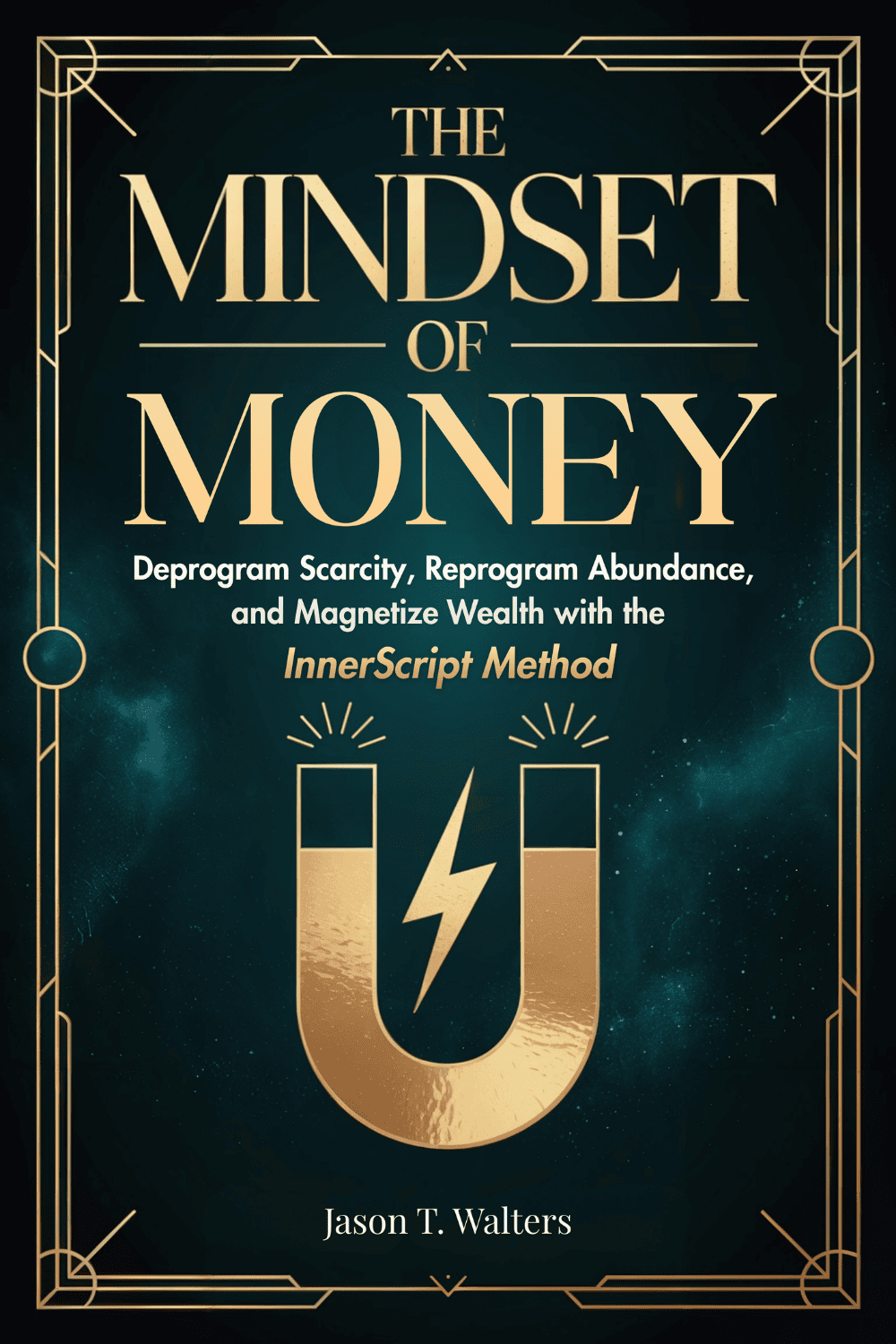
Money affirmations are most powerful when they’re part of a complete system for transforming your relationship with money. This is the framework I teach in my new book, The Mindset of Money: Deprogram Scarcity, Reprogram Abundance, and Magnetize Wealth with the InnerScript Method, which launches January 1, 2026.
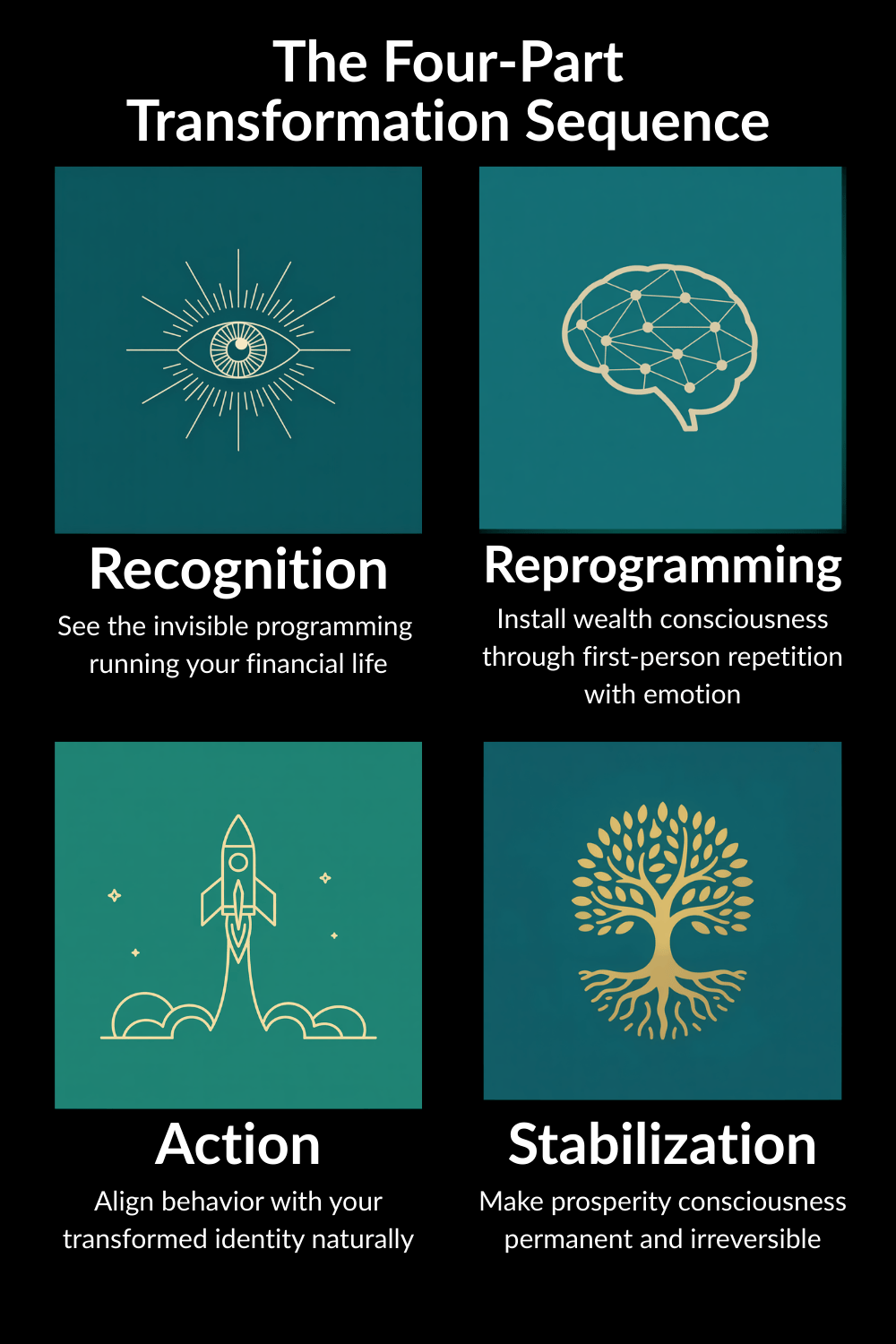
The four-step process works like this:
Step 1: Recognition. First, identify the specific scarcity beliefs running in your subconscious. What messages did you absorb about money as a child? What are your automatic thoughts when you look at your bank account? What beliefs cause you to make poor financial decisions or avoid opportunities? You can’t change programming you haven’t acknowledged.
Step 2: Deprogramming Once you’ve recognized your limiting beliefs, you actively dismantle them. This involves challenging those beliefs with evidence, using techniques like mental contrasting, in which you imagine your desired future and identify the obstacles (which are often internal beliefs rather than external circumstances). This creates space for new programming.
Step 3: Reprogramming. This is where money affirmations come in. You create personalized, first-person affirmations that directly replace your old scarcity beliefs with new abundance beliefs. The key is repetition with emotional engagement. You’re not just saying words, you’re feeling them and visualizing the reality they describe. Over time, through neuroplasticity, these new beliefs become your default programming.
Step 4: Aligned Action Mindset shifts must be followed by behavior changes. If your affirmation is “I take inspired action toward wealth,” then you need to actually take those actions. This might mean asking for a raise, starting a side business, learning about investing, or simply stopping self-sabotaging behaviors like impulsive spending. Action reinforces the new beliefs and proves to your subconscious that change is real.
When you combine all four steps, you create a lasting transformation. The affirmations aren’t just feel-good statements; they’re part of a systematic approach to rewiring your brain for financial success.
Why This Works When Other Methods Fail
The difference between money affirmations that work and those that don’t comes down to how well they align with how your subconscious mind actually processes information. Your subconscious doesn’t respond to logic or willpower alone. It responds to emotion, repetition, and consistency.
Traditional positive thinking often fails because it’s too surface-level. You might tell yourself “I’m rich” during your morning routine, but if you spend the rest of the day worrying about bills and avoiding your bank statements, your behavior is reinforcing scarcity, not abundance. The old programming stays in control because it’s backed up by habitual actions.
The approach I’m sharing here works because it addresses the root cause. By consistently using believable, action-oriented affirmations and taking aligned actions in your real life, you create a feedback loop that convinces your subconscious that change is happening. Your brain starts to accept the new story because it’s experiencing evidence of it.
Studies on habit formation show that creating new neural pathways requires consistent repetition over time, typically around 66 days for new behaviors to become automatic. The same principle applies to thought patterns. When you repeat your money affirmations daily for at least two to three months while taking supporting actions, you’re literally rewiring your brain.
Many people who escape poverty and build wealth attribute their success to a fundamental mindset shift that preceded changes in their external circumstances. Oprah Winfrey, who grew up in extreme poverty, often says, “You become what you believe, not what you want.” Her journey shows that inner conviction, not external validation, fuels success. She held an unshakable belief that she was capable and worthy of more, and that belief guided every choice she made.
You have the same power to change your beliefs and therefore change your financial reality. It starts with recognizing that your current money story is just that, a story. It’s programming that can be rewritten. The affirmations I’ve shared are tools for doing exactly that, but they work best when you understand the deeper process and commit to the full journey of transformation.
The Mindset of Money: Available Now!


Your Next Step: Get the Complete Framework
If you’re serious about transforming your relationship with money and finally breaking free from scarcity thinking, I invite you to check out The Mindset of Money: Deprogram Scarcity, Reprogram Abundance, and Magnetize Wealth with the InnerScript Method.
This isn’t about magical thinking or waiting for the universe to deliver. It’s about taking responsibility for the programming running your life and choosing to install a better operating system. When you change your mind about money, you change your entire financial reality.
The 15 affirmations in this post are a starting point, but they’re just the beginning. Real transformation requires going deeper and staying consistent. That’s what the book provides: a complete roadmap from recognition through stabilization.
Your abundant life is waiting, but it starts in your mind. Change the inner script, and watch the outer world transform to match it.